🔥 “HISTORY IS WATCHING”: STEPHEN COLBERT’S FIERY RESPONSE TO TRUMP’S IRAN THREATS SPARKS NATIONAL DEBATE
In a moment that has quickly ignited intense public discussion, Stephen Colbert has stepped beyond comedy and into the center of a growing geopolitical controversy—delivering a sharp and emotional response to remarks attributed to Donald Trump regarding escalating tensions with Iran.
The comments, which circulated rapidly across media platforms, referenced a potential large-scale military escalation—language that many observers described as alarming and deeply provocative. Among the most widely discussed phrases was a statement suggesting catastrophic consequences for Iran, a remark that critics argue crossed a line from rhetoric into something far more dangerous.
It was against this backdrop that Stephen Colbert, host of The Late Show, addressed the issue during a recent broadcast.
What followed was not a comedic monologue.
It was a direct and forceful statement.
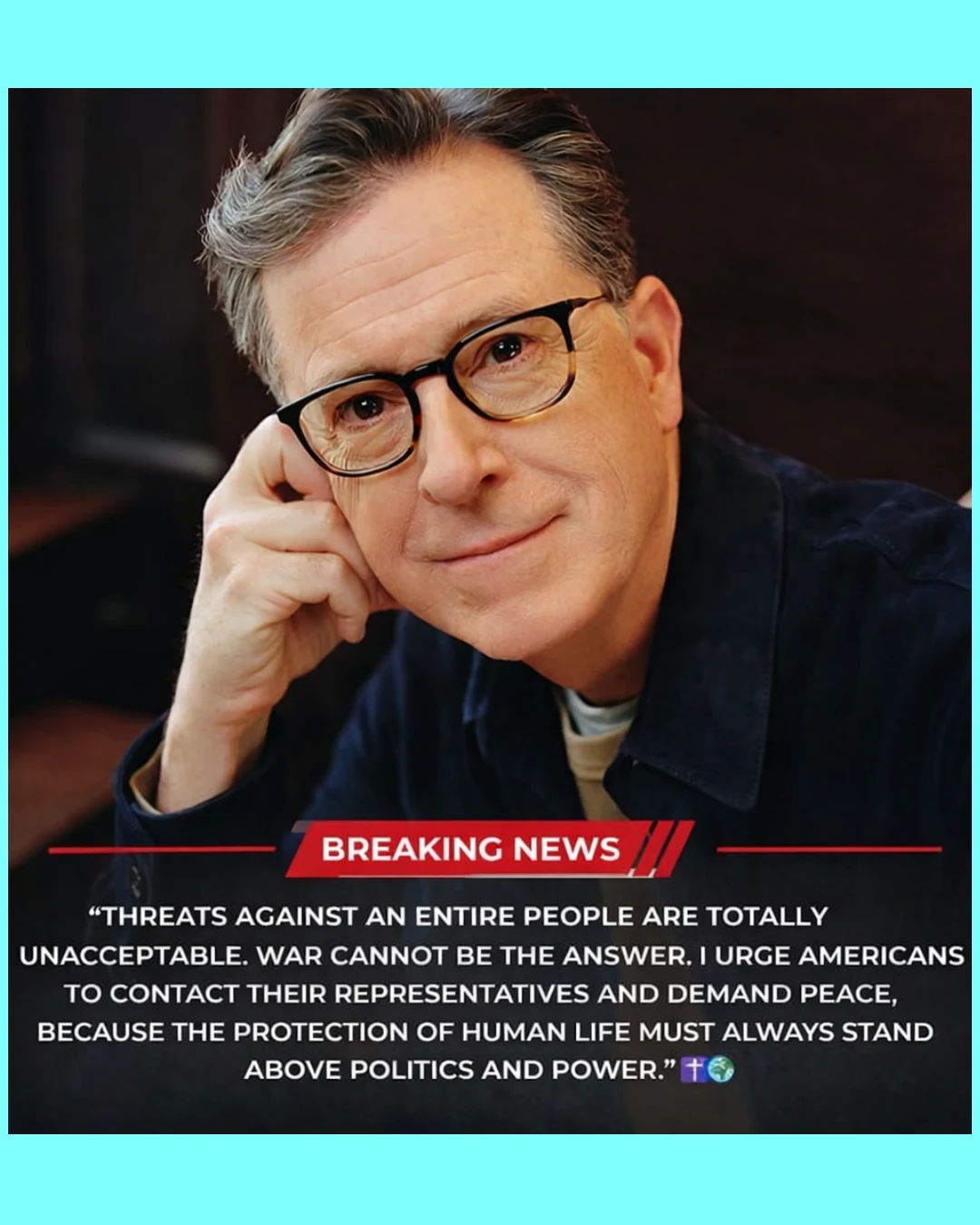
“This is totally unacceptable,” Colbert said, his tone serious and uncharacteristically restrained. The studio audience, accustomed to laughter and satire, responded instead with silence—an indication that the moment had shifted into something more significant.
Colbert made it clear that his reaction was not rooted in partisanship, but in principle.
“This is not about left or right,” he continued. “This is about human lives. This is about the consequences of words that can lead to actions we cannot undo.”
His remarks quickly gained traction, not only because of their content, but because of who was delivering them. As one of the most recognizable voices in American media, Colbert occupies a unique position—bridging entertainment and political commentary in a way that reaches millions of viewers nightly.
And in this instance, he chose to use that platform with unmistakable urgency.
He went on to describe the implications of targeting civilian infrastructure and cultural heritage sites, emphasizing that such actions would violate long-standing principles of international law. While he did not delve into legal technicalities, the message was clear: certain lines, once crossed, cannot be justified.
Observers noted that Colbert’s delivery lacked the usual humor that defines his show. Instead, it carried a weight that reflected the seriousness of the topic.
“He wasn’t performing,” one media analyst remarked. “He was speaking.”
Perhaps the most striking moment came when Colbert turned his attention directly to the American public.
Looking into the camera, he issued a call to action:
“Call your representatives. Demand peace. Do it now.”
It was a rare moment—an entertainer urging civic engagement with a sense of immediacy typically reserved for elected officials or activists. And it did not go unnoticed.
Within minutes, clips of the segment began circulating online. Social media platforms lit up with reactions ranging from strong support to sharp criticism. Supporters praised Colbert for using his voice to highlight what they see as a dangerous escalation of rhetoric, while critics questioned whether a television host should be taking such a definitive stance on matters of foreign policy.
Yet even among differing opinions, there was agreement on one point: the moment was impactful.
“It’s not every day that a late-night host shifts the tone of a national conversation,” one commentator observed. “But this felt like one of those times.”
The broader context surrounding the situation has only amplified the response. Tensions between the United States and Iran have long been a source of global concern, with each new development carrying potential consequences far beyond the immediate region.
In such an environment, language matters.
Statements made by public figures—especially those with significant influence—can shape perception, alter diplomatic dynamics, and, in some cases, escalate already fragile situations.
Colbert’s intervention, therefore, represents more than just a media moment. It reflects the growing role of non-political figures in shaping public discourse around complex global issues.
While some view this as a natural extension of free expression in a democratic society, others see it as a blurring of lines between entertainment and policymaking.
Regardless of perspective, the reaction has been swift and widespread.
Political analysts, journalists, and international observers have all weighed in, examining not only the substance of Colbert’s remarks but also their potential impact. Some have suggested that such moments can influence public opinion in meaningful ways, particularly when they resonate with audiences who may not typically engage with traditional political coverage.
Meanwhile, there has been no immediate, detailed response from Donald Trump directly addressing Colbert’s comments. However, sources indicate that discussions within political circles are ongoing, with attention focused on both the original statements and the reactions they have generated.
For many watching from around the world, the exchange underscores a larger reality: that in an interconnected age, the boundaries between politics, media, and public sentiment are increasingly intertwined.
And as Colbert himself suggested, the stakes are high.
“History is watching,” he said toward the end of his segment—a line that has since been repeated across countless posts, articles, and discussions.
It is a phrase that captures the gravity of the moment, reminding audiences that decisions made today—whether in government offices or on public platforms—can carry lasting consequences.
As the situation continues to evolve, one thing remains certain: this was not just another night of television.
It was a moment that sparked conversation, challenged perspectives, and, for better or worse, added a new voice to an already complex and unfolding global narrative.
“LOWER THE STAGE. I’M COMING DOWN.” — TAYLOR SWIFT’S UNPLANNED MOMENT OF HUMANITY THAT LEFT MILLIONS IN TEARS 009
“LOWER THE STAGE. I’M COMING DOWN.” — TAYLOR SWIFT’S UNPLANNED MOMENT OF HUMANITY THAT LEFT MILLIONS IN TEARS
In an era of meticulously choreographed performances and tightly controlled live broadcasts, moments of genuine spontaneity are rare — and when they happen, they resonate far beyond the stage. That is exactly what unfolded during a recent live performance by Taylor Swift, in a moment that has since captured hearts around the world.
What began as another dazzling night in a sold-out stadium quickly turned into something far more profound — a reminder of the power of empathy, connection, and humanity.
A PERFORMANCE INTERRUPTED
The night had all the hallmarks of a global pop spectacle. Lights pulsed in perfect synchronization, the crowd roared with anticipation, and every movement of the show followed a carefully designed script. Cameras broadcast every second to millions watching live.
Then, something changed.
Midway through one of her songs, Taylor paused.
At first, it was subtle — a slight hesitation, barely noticeable amid the energy of the performance. But then she stepped back, her eyes scanning the crowd with unusual focus. The music softened. The audience grew uncertain.
And then she said the words that would soon echo across social media:
“Lower the stage. I’m coming down.”
BREAKING FROM THE SCRIPT
For a performer known for precision and professionalism, stepping away from the plan during a live broadcast is no small decision. Production crews rely on exact timing; every second matters. But Taylor wasn’t looking at the stage anymore — she was looking into the crowd.
Security hesitated. Crew members exchanged glances. The teleprompter continued to scroll.
But Taylor didn’t wait.
She signaled again — this time more firmly — and the stage platform slowly descended. Without waiting for full clearance, she stepped off and made her way toward the front row.
The cameras followed.
What they captured next was not part of any rehearsal.
A QUIET STORY IN A LOUD CROWD
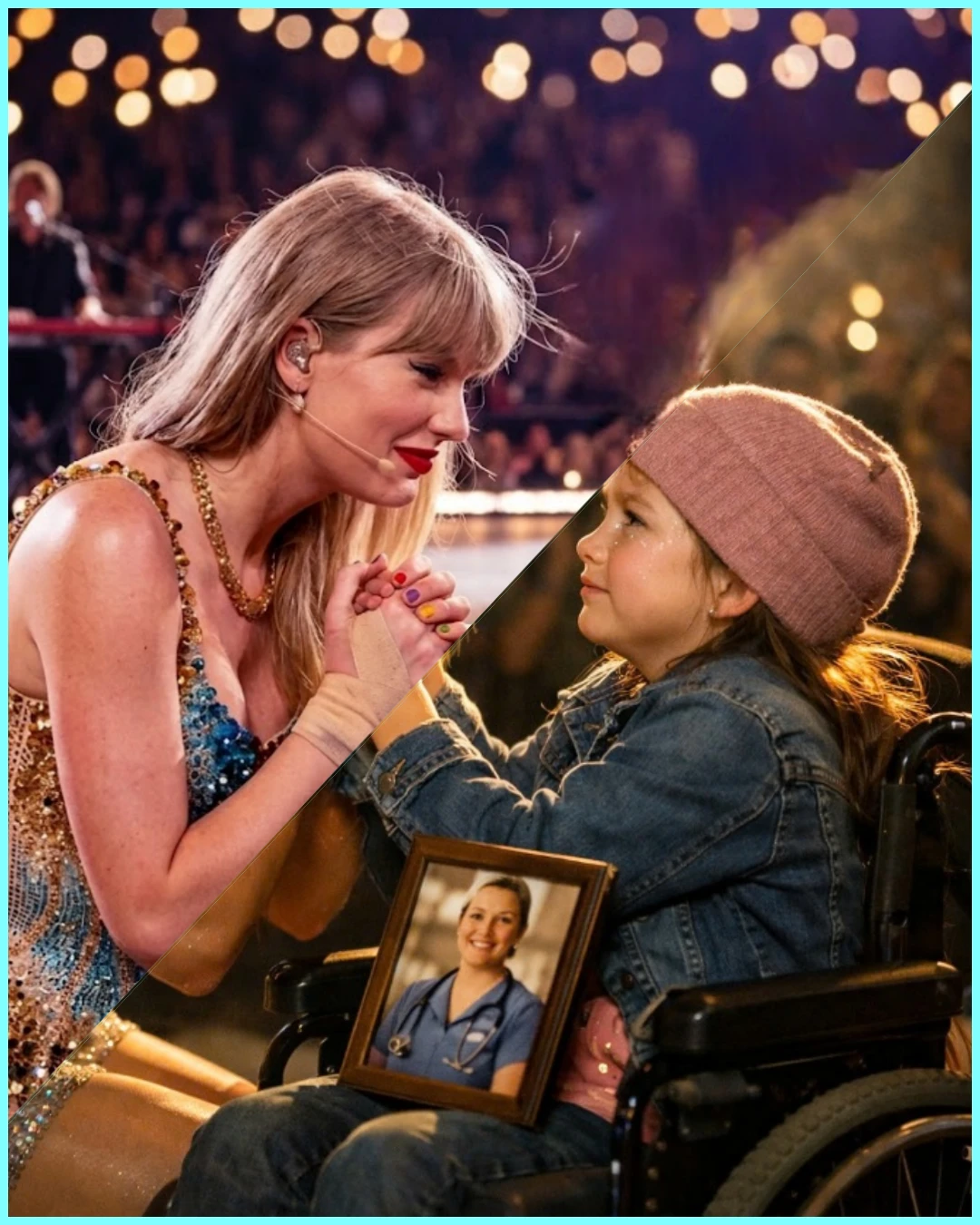
Near the barricade sat a young girl in a wheelchair. In her hands, she held a framed photograph — something she clutched tightly even as thousands of people stood around her.
The image was not of a celebrity.
It was of a nurse.
Taylor approached slowly, her expression shifting from curiosity to understanding in a matter of seconds. She knelt down, bringing herself to the girl’s level, blocking out the noise and spectacle around them.
According to those close to the moment, the nurse in the photograph was the girl’s mother — a frontline healthcare worker who had passed away after serving during a difficult time.
In a stadium filled with sound, the space between them became completely still.
A CONNECTION BEYOND WORDS
What happened next was simple — and unforgettable.
Taylor gently reached out and took the girl’s hands. There was no rush, no dramatic gesture for the cameras. Just care.
Then, in a move that stunned even seasoned viewers, she placed the girl’s hands against her own throat as she began to sing softly.
It was not about the lyrics.
It was about the feeling.
For a child who may not fully experience music in the same way as others, this gesture allowed her to feel the vibrations — to connect physically with the sound in a deeply personal way.
The crowd, once roaring, fell into a hush.
Even through a screen, the emotion was unmistakable.
THE CAMERAS KEEP ROLLING
In live television, moments like this are unpredictable. Producers often cut away, unsure of how to handle unscripted emotional scenes.
But this time, the cameras stayed.
They captured the girl’s expression — a mixture of surprise, emotion, and something deeper that words struggle to define. They captured Taylor’s focus — completely present, completely human.
No grand speech followed.
No attempt to turn the moment into a performance.
Just a quiet exchange between two people in the middle of a global spectacle.
A STADIUM TRANSFORMED
As the song ended, the crowd responded — not with the usual explosive cheers, but with something softer. Applause that felt more like appreciation than excitement.
People were crying.
Strangers held onto each other.
Phones that had been raised to capture a concert were now recording something far more meaningful.
When Taylor eventually returned to the stage, the energy had shifted. The show continued, but it carried a different weight — a reminder that even in the largest arenas, the smallest moments can matter most.
WHY THIS MOMENT MATTERS
In today’s digital world, audiences are often skeptical of what they see. Viral moments can feel staged, manufactured for clicks and attention.
But this felt different.
There was no buildup. No teaser. No marketing angle.
Just a decision — made in real time — to step off a stage and connect with someone who needed it.
For fans, it reinforced something they have long believed about Taylor Swift: that behind the global fame and polished image is a person who notices, who cares, and who acts.
For others, it was a reminder that compassion doesn’t require perfection — just presence.
THE STORY BEHIND THE STORY
Since the broadcast, conversations online have focused not only on Taylor’s gesture but also on the story of the girl and her mother.
Healthcare workers around the world have shared their own experiences, reflecting on the sacrifices made by frontline professionals. Many have described the moment as a tribute — not just to one individual, but to countless others whose stories often go unseen.
The framed photograph became a symbol.
Not of loss alone, but of memory, love, and resilience.
A MOMENT THAT LINGERS
Long after the lights dimmed and the final song ended, this moment remained.
Clips spread rapidly across platforms. Millions watched, shared, and commented. Some called it the highlight of the entire tour. Others described it as one of the most genuine moments they had ever seen on a live broadcast.
But perhaps its true impact lies in something quieter.
In a world that often moves too fast, where performances are measured in views and metrics, this was a pause — a reminder that connection still matters.
MORE THAN A PERFORMANCE
At its core, this was not about music.
It was about empathy.
About seeing someone in a crowd of thousands and choosing to go to them.
About turning a global stage into a personal moment.
And about proving that sometimes, the most powerful thing a performer can do… is simply step down.