free web site hit counter “THEY NAILED THE LANDING… THEN COULDN’T EVEN STAND: ARTEMIS II ASTRONAUTS STUN THE WORLD AS PERFECT SPLASHDOWN TURNS INTO A SHOCKING MOMENT OF HUMAN LIMITATION” What was supposed to be a flawless, celebratory return from deep space quickly shifted into something far more unsettling as footage from the recovery ship showed the Artemis II crew struggling to steady themselves just moments after completing their historic “bullseye” landing, with gravity hitting their bodies so suddenly that every step looked like a battle against exhaustion and disorientation. After days away from Earth, the return to normal weight conditions exposed the brutal, unseen reality of space travel — where even elite astronauts must relearn balance, movement, and control in real time while cameras continue rolling. And as the video spreads rapidly across the world, viewers are now questioning what other physical effects are never shown once the spacecraft doors open. Because according to one NASA recovery team member, what the public saw on deck was only the surface of the situation — and early medical readings reportedly revealed reactions in the astronauts’ bodies that even specialists weren’t fully prepared for… SEE DETAILS BELOW 👇👇👇 -

“THEY NAILED THE LANDING… THEN COULDN’T EVEN STAND: ARTEMIS II ASTRONAUTS STUN THE WORLD AS PERFECT SPLASHDOWN TURNS INTO A SHOCKING MOMENT OF HUMAN LIMITATION” What was supposed to be a flawless, celebratory return from deep space quickly shifted into something far more unsettling as footage from the recovery ship showed the Artemis II crew struggling to steady themselves just moments after completing their historic “bullseye” landing, with gravity hitting their bodies so suddenly that every step looked like a battle against exhaustion and disorientation. After days away from Earth, the return to normal weight conditions exposed the brutal, unseen reality of space travel — where even elite astronauts must relearn balance, movement, and control in real time while cameras continue rolling. And as the video spreads rapidly across the world, viewers are now questioning what other physical effects are never shown once the spacecraft doors open. Because according to one NASA recovery team member, what the public saw on deck was only the surface of the situation — and early medical readings reportedly revealed reactions in the astronauts’ bodies that even specialists weren’t fully prepared for… SEE DETAILS BELOW 👇👇👇

The Artemis II crew has safely returned to Earth after completing a historic lunar flyby mission, but newly surfaced footage showing astronauts struggling to walk shortly after landing has sparked global attention and renewed focus on the physical toll of deep space travel.

Following a flawless “bullseye” splashdown in the Pacific Ocean off the coast of San Diego, the four astronauts—Reid Wiseman, Victor Glover, Christina Koch, and Jeremy Hansen—were recovered from their Orion spacecraft and transferred onto a U.S. Navy vessel for initial medical checks and post-mission procedures.
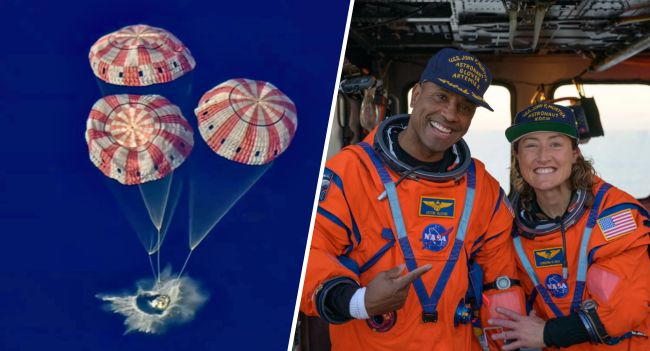
A TEXTBOOK RETURN AFTER A HISTORIC LUNAR MISSION

The mission itself marked a major milestone for NASA, successfully sending humans farther than any spacecraft has traveled since Apollo 17. The Orion capsule re-entered Earth’s atmosphere at extreme speeds exceeding 25,000 mph, enduring intense heat and a brief communications blackout before deploying parachutes and landing precisely as planned.

NASA officials later described the landing as a “perfect bullseye,” emphasizing the success of the spacecraft’s heat shield, navigation systems, and recovery operations.

STRUGGLING TO WALK AFTER RETURNING TO GRAVITY

All four members of the Artemis II crew were supported by a person on each side, while a third assistant pushed a wheelchair behind them in case it was needed, after arriving back from their moon mission

However, what happened moments after recovery quickly became a focal point of public fascination.

Video footage from the recovery vessel shows the astronauts requiring assistance as they adjusted to Earth’s gravity after spending days in microgravity conditions. Each crew member was supported by medical staff while moving across the deck, with careful monitoring as their bodies readjusted to weight after an extended period in space.

Christina Koch, Artemis II mission specialist, is supported to walk as she arrives aboard USS John P Murtha

NASA confirmed that such reactions are expected and temporary, explaining that even short-duration missions can temporarily affect balance, coordination, and muscle response.

WHY SPACE TRAVEL AFFECTS THE HUMAN BODYVictor Glover, left and Jeremy Hansen, right, after they and fellow crewmates were extracted from their Orion spacecraft after splashdown

Experts note that exposure to microgravity causes rapid physiological changes, even during relatively brief missions. These include fluid redistribution, muscle deconditioning, and inner-ear balance disruption, all of which can make standing and walking difficult immediately after return.

Although the Artemis II mission lasted only around 10 days, it was conducted in deep space beyond low Earth orbit, intensifying the effects compared to standard orbital missions.

Victor Glover, left, and Christina Koch, right, after successfully splashing down following their historic moon mission

NASA has long prepared astronauts for this phase of recovery, using post-landing mobility tests and rehabilitation protocols to help them gradually readjust to Earth’s gravity.

A SUCCESSFUL MISSION WITH HUMAN LIMITATIONS ON DISPLAY

Despite the dramatic visuals, NASA officials emphasized that all four astronauts were in excellent condition following landing and were cleared for standard recovery procedures.Astronauts Victor Glover and Christina Koch were seen waving and hugging NASA chief Jared Isaacman after being pulled from the water

The crew’s post-landing appearance, however, served as a powerful reminder that space exploration is not only a technological challenge, but also a profound physiological test for the human body.

THE NEXT PHASE OF LUNAR EXPLORATION

Artemis II is widely viewed as a critical stepping stone toward future lunar landings and the development of long-term human presence on the Moon under NASA’s Artemis program.

As attention now shifts toward Artemis III and beyond, scientists continue studying data from the mission to better understand how astronauts can be protected during longer and more complex journeys.

A MOMENT THAT REDEFINED HUMAN SPACE EXPLORATION

While the mission will be remembered for its precision landing and record-breaking lunar distance, it is the images of astronauts regaining their footing on Earth that have captured global attention—highlighting both the triumph and vulnerability of human spaceflight.

And according to one NASA medical specialist involved in the recovery operation, the most revealing insights may still be coming—because early physiological data from the crew reportedly includes unexpected responses that researchers say could “reshape how future deep-space missions are planned”…


Related Posts

NO PERFORMANCE… JUST A FEW WORDS — AND FANS CAN’T STOP ANALYZING THEM.” Ilia Malinin has finally shared a quiet post-season update, and while nothing seemed dramatic on the surface, viewers are already zeroing in on one small detail. There were no jumps, no routines — just a calm, measured moment that felt different from his usual on-ice presence. But it’s what he hinted at, not what he said outright, that’s now driving the conversation. The video is gaining traction fast, with fans replaying every second, trying to read between the lines… because sometimes, the real story doesn’t happen during the performance — it starts after 👀👇

  Ilia Malinin has taken a major step beyond the ice, launching his first official YouTube channel and giving fans an intimate look into his life after the…

“I HAD TO LIVE LIKE HIM… NOT JUST PLAY HIM.” Jaafar Jackson didn’t just study Michael Jackson — he stepped into his world in a way fans never expected, sleeping on the floor of the very home where the legend was born, chasing every feeling, every memory, every hidden weight behind the fame. What started as preparation quickly turned into something deeper, more intense, as he tried to understand the pressure, the pain, and the early struggles that shaped the King of Pop into a global icon. Now, as the biopic builds unstoppable momentum, fans are split between admiration and unease — some calling it the ultimate tribute, others wondering how far is too far when becoming someone else. One thing is certain: this isn’t just a performance anymore… it’s a transformation people can’t stop talking about. 👉 SEE THE FULL STORY AND WHAT HE DID TO BECOME HIM BELOW 👇👇👇

In a deeply dedicated and somewhat shocking revelation, Jaafar Jackson has opened up about the extreme lengths he went to in order to prepare for his role…

“HE BECAME MICHAEL” 🥹: Jackie Jackson grew emotional speaking about nephew Jaafar Jackson and his transformation into Michael Jackson for the biopic Michael. Those who’ve seen early glimpses say the resemblance is almost uncanny, so much so that even family members reportedly did a double take. ▶️ Watch Jackie Jackson react to the moment Jaafar stepped into Michael’s shoes 👇

Jackie Jackson became visibly emotional while speaking about his nephew Jaafar Jackson and his remarkable transformation into the late Michael Jackson for the upcoming biographical film Michael, set to hit theaters on April…

Here’s her transformation captured in photos 😳👇

Shirley MacLaine. Credit: Getty Images Aging is something we all will go through. Meanwhile, some, especially in Hollywood, decide to use Botox, facelifts, or plastic surgery to…

It’s been called the ‘worst recording ever made.’ 😱

Timothy Treadwell became world-famous overnight — but for a tragic reason. In 2003, he and his girlfriend Amie Huguenard set out for Katmai National Park in Alaska….

The First Lady reportedly let him know 😳

Barron and Melania Trump. Credit / Getty Images Melania Trump has reportedly lashed out at Eric Trump after he publicly discussed Barron, challenging years of effort to…