“You’re Not Walking Alone” — The Midnight Pact Between Vince Gill and Dolly Parton That Became Reba McEntire’s Most Personal Gift After Losing Her Son
Late on the night of August 8, Vince Gill’s voice cracked over the phone as he spoke to Dolly Parton. “We have to do something for her, Dolly. Reba’s in more pain than I’ve ever seen her in.” It wasn’t just sympathy—it was the urgency of two lifelong friends who had walked side-by-side with Reba McEntire through decades of music, loss, and triumph. Dolly’s own voice trembled as she answered, “I just lost my husband… and only months later, she’s lost her son. Lord, I can’t let her go through this without knowing we’re here.” Within the hour, Vince was standing at Dolly’s doorstep in Nashville, guitar in hand, the moonlight catching the silver on his strings… WATCH VIDEO BELOW 
They didn’t sleep. Sitting at Dolly’s kitchen table with coffee that went cold untouched, they pieced together the final verses of a song they’d been quietly working on for months—a ballad about faith, resilience, and the kind of love that never stops, even when someone is gone. By 6 a.m., the sky had turned a soft Tennessee blue. Dolly suggested they record a simple version, no studio, no fancy mics—just heart.
At 9 o’clock sharp on the morning of August 9, they moved to the front porch of Dolly’s home, a place that had been the backdrop of countless songwriting sessions but never one quite like this. Vince sat on the top step, Dolly beside him, both barefoot, leaning against the white wooden railing. Birdsong and the hum of the summer air wove into the melody as they began to sing the song now titled “You’re Not Walking Alone.” By the final chorus, Dolly’s voice softened into a whisper, and Vince’s guitar faded into silence. Without a word, they uploaded the raw recording and sent it straight to Reba’s phone.
NASHVILLE, TN — In the quiet hours of August 8, as most of Nashville lay still, Vince Gill’s voice broke with urgency over the phone. “We have to do something for her, Dolly,” he said, each word weighed down by grief. “Reba’s in more pain than I’ve ever seen her in.” On the other end, Dolly Parton went silent for a long moment before finally speaking, her tone heavy with her own recent heartbreak. “I just lost my husband… and only months later, she’s lost her son. Lord, I can’t let her go through this without knowing we’re here.”
Within the hour, Vince was at Dolly’s front door. He carried only a guitar and a look that told her they wouldn’t be sleeping that night. The two country legends settled at Dolly’s kitchen table, the hum of the old refrigerator and the soft ticking of a wall clock filling the silence between scribbled lyrics. A pot of coffee sat forgotten, cooling in the corner, as they pulled from decades of shared music-making and deep friendship with Reba McEntire.
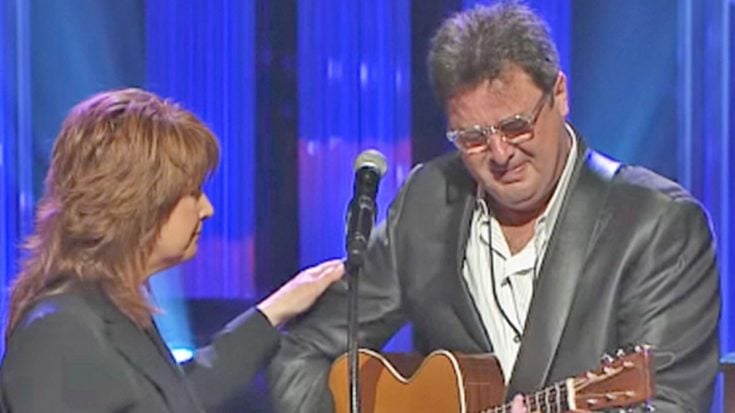
What they were writing wasn’t just a song—it was a lifeline. They had been quietly working on a piece for months, but now the words seemed to pour out faster, shaped by the urgency of the moment and the rawness of Reba’s loss. By 6 a.m., the Tennessee sky had begun to pale, the first hints of sunlight brushing the tops of the trees outside Dolly’s kitchen window.
“We don’t need a studio for this,” Dolly said firmly. “We just need heart.” At 9 o’clock sharp on the morning of August 9, they stepped onto Dolly’s wide front porch, barefoot, the air already warm with summer. Vince sat on the top step, Dolly beside him, both leaning against the white wooden railing that had heard so many of their private rehearsals over the years.
There were no cameras, no sound engineers—just Vince’s guitar and their voices. Birds chirped in the background, cicadas hummed low in the distance, and the creak of the porch boards under their shifting weight added an intimacy that no studio could replicate. The song, now titled “You’re Not Walking Alone,” was a tender ballad about enduring love, the kind that bridges even the deepest loss.
The first verse came like a prayer: a reminder that absence doesn’t erase connection, that love can still be felt in the wind, the rain, the quiet moments no one else sees. By the second chorus, Dolly’s voice caught, her breath trembling through the melody, while Vince’s guitar wrapped her words in a warm, steady rhythm.

When the final note faded, neither spoke. They simply exchanged a glance, one that carried decades of shared history, unspoken gratitude, and the certainty that they had done something important—not for charts, not for fans, but for a friend who needed them.
The raw recording was sent directly to Reba’s phone, no fanfare, no advance warning. Friends close to her say she was sitting alone in her Tennessee farmhouse when it arrived. She pressed play, and for the next few minutes, the world outside her grief fell away. She listened three times before sending her reply: “I feel him with me now.”
In an industry built on spectacle, Vince Gill and Dolly Parton had chosen something far rarer—quiet, unpolished love. And for Reba McEntire, who had just said goodbye to her son, it was the only kind of music that mattered.