“He was hours away from chasing an Olympic medal… then officials told him to take off the helmet.” 

Ukrainian skeleton racer Vladyslav Heraskevych has been kicked out of the Olympics in one of the most controversial episodes in Games history after refusing to replace a helmet depicting victims of the Russian invasion.
The confirmation of his expulsion arrived less than an hour before he was due to compete as a serious medal contender in Cortina, with the International Olympic Committee now braced for a fierce backlash for applying no leeway to their rules around political messaging.
IOC president Kirsty Coventry made one last-ditch attempt on Thursday morning to persuade Heraskevych – who has family fighting on the frontline – to end the stand-off, but with neither party willing to budge, the 27-year-old has had his accreditation stripped. It is currently unclear if he will now be ejected from the Olympic village entirely.
Coventry choked up as she told reporters that it had been an ’emotional morning’.
‘I was not meant to be here, but I thought it was really important to come here and talk to him face to face. No one, especially me, is disagreeing with the messaging, it’s a powerful message, it’s a message of remembrance, of memory,’ the IOC president said.
‘The challenge was to find a solution for the field of play. Sadly, we’ve not been able to find that solution. I really wanted to see him race. It’s been an emotional morning.’

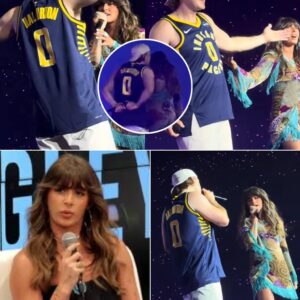
Vladyslav Heraskevych (pictured) has been banned from competing at the Winter Olympics after he refused to back down from wearing a helmet that featured images depicting victims of the Russian invasion of Ukraine

Mykhailo Heraskevych (left), Vladyslav’s father and coach, was devastated upon learning of the news

IOC president Kirsty Coventry (pictured) choked up as she faced reporters, explaining that ‘she really wanted Heraskevych to race’ before stating that it had been an ’emotional morning’
Heraskevych’s immediate response was to post on social media: ‘This is the price of our dignity.’
The Ukrainian later said: ‘I am disqualified from the race. I will not get my Olympic moment.
‘They were killed, but their voice is so loud that the IOC is afraid of them. I told Coventry that this decision plays along with Russia’s narrative.
‘I sincerely believe that it is precisely because of their sacrifice that these Olympic Games can take place at all today.
‘Even though the IOC wants to betray the memory of these athletes, I will not betray them.’
It is a desperately sad end to an astonishing saga and Heraskevych, the flag bearer for Ukraine at last week’s opening ceremony, will doubtless be lauded for giving up his medal prospects on a hugely evocative point of principle.
In heartbreaking scenes, Heraskevych’s father and coach, Mykhailo, was also seen perched on a mound of snow crying, after learning of the news.
The IOC released a statement at 8.10am local time, which said: ‘Having been given one final opportunity, skeleton pilot Vladyslav Heraskevych from Ukraine will not be able to start his race at the Milano Cortina 2026 Olympic Winter Games this morning.

Heraskevych’s immediate response was to post on social media: ‘This is the price of our dignity’

The 27-year-old has had his accreditation stripped. It is currently unclear if he will now be ejected from the Olympic village entirely.

Heraskevych had arrived to speak to members of the media with the helmet. He said: ‘Even though the IOC wants to betray the memories of these athletes, I will not betray them’

The Ukrainian Olympic team will take the case to the Court of Arbitration for Sport (Pictured: Heraskevych’s dad and coach, Mykhailo)

Coventry (right) made one last-ditch attempt on Thursday morning to persuade Heraskevych to end the stand-off
‘The decision followed his refusal to comply with the IOC’s guidelines on athlete expression. It was taken by the jury of the International Bobsleigh and Skeleton Federation (IBSF) based on the fact that the helmet he intended to wear was not compliant with the rules.
‘The International Olympic Committee has therefore decided with regret to withdraw his accreditation for the Milano Cortina 2026 Games.
‘Despite multiple exchanges and in-person meetings between the IOC and Mr Heraskevych, the last one this morning with IOC President Kirsty Coventry, he did not consider any form of compromise.
‘The IOC was very keen for Mr Heraskevych to compete. This is why the IOC sat down with him to look for the most respectful way to address his desire to remember his fellow athletes who have lost their lives following Russia’s invasion of Ukraine. The essence of this case is not about the message, it is about where he wanted to express it.
‘Mr Heraskevych was able to display his helmet in all training runs. The IOC also offered him the option of displaying it immediately after the competition when going through the mixed zone.
‘Mourning is not expressed and perceived in the same way everywhere in the world. In order to support athletes in their mourning, the IOC has put in place multifaith centres in the Olympic Villages and a place of mourning, so that grief can be expressed with dignity and respect. There is also the possibility to wear a black armband during competition under certain circumstances.
‘During the Olympic Games, athletes are also offered a number of opportunities to mourn and express their views, including in the media mixed zones, on social media, during press conferences and in interviews.’
The IOC, which had been trapped between a rock and a hard place over such a charged topic, added: ‘The Guidelines on Athlete Expression were the result of a global consultation in 2021 with 3,500 athletes from all around the world. They have the full support of the IOC Athletes’ Commission and Athletes’ Commissions from International Federations and National Olympic Committees.

Heraskevych took to Instagram to make one last plea not to be disqualified hours before Olympic bosses made the announcement
‘Mr Heraskevych has been supported by the IOC for the last three editions of the Olympic Winter Games. Each time he was an Olympic scholarship holder. Following Russia’s invasion of Ukraine in 2022, the IOC also set up a solidarity fund for Ukrainian sport to support the athletes’ preparations for the Paris 2024 Olympic Games.’
Heraskevych had pre-empted his disqualification with a final demand to the IOC to relent.
Taking to social media just two hours before the start of the skeleton competition at 9.30am local time on Thursday, he made it clear he would not cave in, leaving the IOC in the fiendish spot of having to relax their position on political messaging, or eject a Ukrainian hero.
He wrote: ‘I never wanted a scandal with the IOC, and I did not create it. The IOC created it with its interpretation of the rules, which many view as discriminatory.
‘Although this scandal has made it possible to loudly speak about Ukrainian athletes who have been killed, at the same time the very fact of the scandal distracts a tremendous amount of attention away from the competitions themselves and from the athletes participating in them.
‘That is why I propose to end the scandal. I ask: 1. Lift the ban on the use of the “Memory Helmet”. 2. Apologise for the pressure that has been put on me over the past few days. 3. As a sign of solidarity with Ukrainian sport, provide electric generators for Ukrainian sports facilities that are suffering from daily shellings.
‘I very much hope for a response before the start of the skeleton competitions.’
The response was not the one he wanted. For the IOC, this will also be the worst PR imaginable, though Daily Mail Sport understands their position was governed by a fear that allowing Heraskevych to wear the helmet would inevitably see those from other nations doing the same, potentially in support of questionable regimes.

In a statement released on Thursday morning, the IOC said it would permit Heraskevych to wear the helmet in training runs but not during competition because it did not comply with the IOC’s rules on athlete expression
Heraskevych later expanded on his disappointment to reporters, adding: ‘It’s hard to say or put into words. It’s emptiness.
‘I do not get my moment at this Olympics, despite I would say pretty good results in the training runs. I really believe we could be among the medallists today and tomorrow, but we will not be able to race.
‘I believe we didn’t violate any rules. In the press conference, it was told to me that I violated Rule 50. Here we have rules regarding expression, so it’s not Rule 50. I see big inconsistencies in decisions, in the wording, in the press conferences of the IOC, and I believe it’s the biggest problem that it’s inconsistent.
‘Also what [is] painful is that it looks like discrimination because athletes were already expressing themselves.’
Heraskevych intends to appeal to the Court of Arbitration for Sport, but that will prove largely academic on the basis that the competition has now started.
Double Olympic champion Lizzy Yarnold, speaking on the BBC, said the IOC owe him an apology. She said: ‘It’s actually quite shocking. Lots of the sliding community have been in contact straight away.
‘There is shock and confusion. Taking away his accreditation means he now needs to leave the Olympic Games.
‘The reaction to something which was an act of memorial, incredibly emotionally important to him. I’m quite shocked. I think the IOC owe him an apology. I think this was the wrong decision. He was also a medal contender for the race. He’s a phenomenal athlete.’