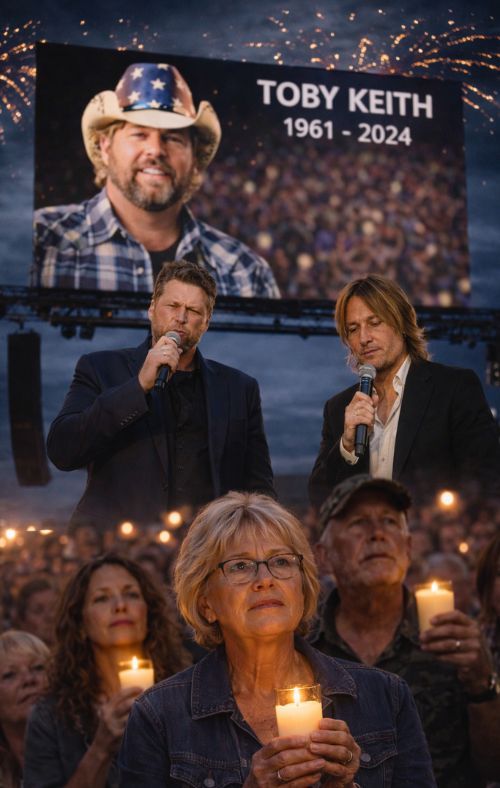
“🔥 THE NIGHT TOBY KEITH ANSWERED BACK FROM THE SILENCE. There were no cameras. No press. Just dusk settling over Oklahoma and two familiar silhouettes standing where words no longer worked. Keith Urban stepped forward first, boots brushing gravel, and hummed a melody so quiet it felt like a memory. Blake Shelton joined in, voice rough, unfinished — “the kind that carries things you don’t say out loud.” They weren’t performing. They were answering something. As the harmony held, the air shifted. Flags stirred. Someone whispered, “He’s here.” No one laughed. When it ended, no speeches followed — only a hand on stone, and a murmur meant for one man alone: “We got you, brother.” And the silence… didn’t push back this time.” ▶️ 𝐂𝐥𝐢𝐜𝐤 𝐭𝐨 𝐩𝐥𝐚𝐲 𝐅𝐮𝐥𝐥 𝐕𝐢𝐝𝐞𝐨!

Introduction

When the Silence Finally Answered: The Night Toby Keith Was Felt More Than Heard

There are tribute moments in country music that feel planned, polished, and carefully framed for public memory. And then there are moments that seem to arrive from somewhere deeper—moments that do not ask for applause because they are already carrying too much weight. That is the emotional force inside 🔥 THE NIGHT TOBY KEITH ANSWERED BACK FROM THE SILENCE. It reads like the beginning of legend, but what gives it real power is not drama for its own sake. It is the quiet ache beneath it. It is the feeling that grief, loyalty, and music can meet in one place and create something that feels almost too personal for an audience to witness.

What makes this image so compelling is the setting. Not an arena. Not televised special. Not stage crowded with lights and rehearsed speeches. Just dusk in Oklahoma, two familiar figures, and the kind of silence that only exists when everyone present understands that words have reached their limit. For older listeners especially, this kind of scene carries enormous emotional truth. Life teaches people that some of the most important goodbyes do not happen in public. They happen in fading light, beside stone, memory, or open land, where people say only what absolutely needs to be said.

That is why 🔥 THE NIGHT TOBY KEITH ANSWERED BACK FROM THE SILENCE. lands so deeply. Toby Keith was never an artist associated with fragility. He stood for boldness, conviction, and kind of unmistakable presence that filled the room long before the first lyric ever arrived. To imagine tribute to him built not on spectacle, but on stillness, is to understand that true absence can be louder than any anthem. When voice like his is gone, silence itself becomes part of the story.

The presence of Keith Urban and Blake Shelton gives the moment another layer of meaning. Both are artists with distinct voices and identities, yet here they are imagined not as stars stepping forward for attention, but as men answering loss they can no longer argue with. The detail of Keith humming first is especially moving. hum is more intimate than full performance. It belongs to memory, to instinct, to feeling before language. Then Blake joins in, his rougher tone suggesting the unfinished business grief always leaves behind. Together, they are not merely singing. They are carrying something.

And then comes the line that gives the whole scene its haunting power: someone whispers, “He’s here.” Whether taken literally, spiritually, or emotionally, it captures the way music can collapse the distance between presence and absence. For people who have lost someone dear, that feeling is instantly recognizable. There are moments when memory becomes so alive it no longer feels like memory alone.

What lingers most, though, is the ending. No speeches. No need to explain the moment away. Just hand on stone and the words, “We got you, brother.” That is country music at its most human—plain, loyal, unadorned, and devastatingly sincere. In the end, 🔥 THE NIGHT TOBY KEITH ANSWERED BACK FROM THE SILENCE. is powerful not because it imagines ghostly return, but because it understands something truer: sometimes the deepest answer from the silence is the bond left behind between those who remain.

Video

Related Posts

““AFTER YEARS ON STAGE, THIS WAS GWEN STEFANI’S MOST HUMAN MOMENT.” Love took center stage in Nashville when Gwen Stefani paused her Denim & Rhinestones tour and smiled like she was about to share a secret. Then she called her “rock,”Blake Shelton, onto the Bridgestone Arena stage. There was a little nervous laughter. A hand squeeze. No rush. They sang Look at Me. The notes weren’t polished. They were honest. Soft. Real. Every glance said more than the lyrics ever could. You could feel the room lean in, all 30,000 people understanding this wasn’t a performance. It was a moment. When the last line faded, the applause felt like a thank-you. For letting us see love, unfiltered.””””” ▶️ 𝐂𝐥𝐢𝐜𝐤 𝐭𝐨 𝐩𝐥𝐚𝐲 𝐅𝐮𝐥𝐥 𝐕𝐢𝐝𝐞𝐨!

Introduction When Gwen Stefani Let the Spotlight Fall Away, Nashville Saw Something Far More Beautiful Than Perfection There are nights in arena music when everything is designed to dazzle — the wardrobe, the lights, the timing, the polished confidence of performers who know exactly how to command a crowd. But every so often, a moment slips through that feels untouched by rehearsal. It does not impress because it is flawless. It stays with people because it is exposed, tender, and unmistakably real. That is the kind of moment this was. “AFTER YEARS ON STAGE, THIS WAS GWEN STEFANI’S MOST HUMAN MOMENT.” Love took center stage in Nashville when Gwen Stefani paused her Denim & Rhinestones tour and smiled like she was about to share a secret. Then she called her “rock,” Blake Shelton, onto the Bridgestone Arena stage. There was a little nervous laughter. A hand squeeze. No rush. They sang Look at Me. The notes weren’t polished. They were honest. Soft. Real. Every glance said more than the lyrics ever could. You could feel the room lean in, all 30,000 people understanding this wasn’t a performance. It was a moment. When the last line faded, the applause felt like a thank-you. For letting us see love, unfiltered. What makes this scene so moving is not simply that Gwen and Blake sang together, but that they seemed willing to let the song remain fragile. In a world where celebrity often arrives packaged, edited, and emotionally protected, this kind of openness feels rare. Gwen Stefani has spent decades in public life, evolving through styles, eras, and reinventions, always carrying a sense of command and artistry. Yet here, what reached people most deeply was not command. It was vulnerability. For older listeners especially, that distinction matters. With time, people come to recognize that the most memorable moments are not always the most technically perfect. They are the ones that reveal truth. A voice that shakes slightly. A pause that was not planned. A glance between two people that says, without effort, we have lived enough to know what matters. That is why the image of a hand squeeze before the song begins feels so important. It suggests reassurance, affection, and the quiet courage it takes to be emotionally visible in front of thousands. The choice of “Look at Me” makes the moment even more intimate. It is not a song that depends on spectacle. It invites closeness. It asks for attention of a different kind — not the loud attention of applause, but the hushed attention that comes when an audience senses something personal unfolding in real time. And that is precisely what seems to have happened. The crowd did not merely watch. It leaned in. That collective leaning in is one of the surest signs that a performance has crossed into something more human. Blake Shelton’s presence in the moment matters too, not because he arrives as a star in his own right, but because he seems to meet Gwen in softness rather than showmanship. There is no sense here of either person trying to outshine the other. Instead, the duet feels like a mutual lowering of defenses. That is why the performance resonates. Love, especially mature love, rarely looks like grand declarations alone. More often, it appears in patience, steadiness, shared breath, and the ease of being unguarded with someone in full view of the world. In the end, what people likely carried home was not a memory of vocal perfection or stagecraft. It was the feeling of having witnessed two people choose sincerity over polish. And for an audience of thirty thousand, that kind of honesty can feel almost intimate. The applause at the end was not merely approval. It was gratitude. Gratitude for the reminder that even after years in the spotlight, the moments that move us most are still the simplest ones — a song, a hand, a glance, and the rare gift of love left unfiltered. Video

“NO CAMERAS, NO STAGE — JUST THREE FRIENDS SINGING FOR TOBY KEITH ONE LAST TIME There were no spotlights that night. No cheering crowd. No television cameras waiting to turn grief into a headline. Just the Oklahoma air, still and heavy with memory, and three men who had once stood beside Toby Keith in the loud, blazing world of country music. Blake Shelton, Keith Urban, and Trace Adkins returned quietly to Norman, carrying no performance with them — only love, history, and the kind of sorrow that does not need an audience. Blake held an old acoustic guitar, the sort Toby once made sound larger than any stadium. Together, they sang softly into the silence, as if afraid to disturb the weight of the moment. When the final chord faded, no one rushed to speak. Because sometimes the deepest tribute is not a public farewell. It is the private ache of friendship… still singing after the voice is gone.” ▶️ 𝐂𝐥𝐢𝐜𝐤 𝐭𝐨 𝐩𝐥𝐚𝐲 𝐅𝐮𝐥𝐥 𝐕𝐢𝐝𝐞𝐨!👇👇

Introduction When the Applause Was Gone: The Quiet Farewell Toby Keith’s Closest Friends Never Needed the World to See In country music, the biggest moments are often…

““THE SONG ENDED — BUT THEY DIDN’T LET GO” Sometimes the most powerful moment in a concert happens after the music stops. As the final note faded and the applause filled the room, Blake Shelton and Gwen Stefani stood together under the lights for just a little longer than expected. There were no dramatic gestures, no grand finale. Blake simply reached out and took Gwen’s hand. And instead of letting go right away, he held it. The crowd kept cheering, but something about that quiet pause changed the atmosphere in the room. It felt less like the end of a performance and more like a glimpse into a private moment that thousands of people happened to witness. Gwen smiled softly, and Blake gave the audience that familiar grin — yet neither seemed in a hurry to step away. In a world of carefully choreographed concerts, the simplicity of that lingering handhold said more than any lyric ever could.” ▶️ 𝐂𝐥𝐢𝐜𝐤 𝐭𝐨 𝐩𝐥𝐚𝐲 𝐅𝐮𝐥𝐥 𝐕𝐢𝐝𝐞𝐨!

Introduction When the Music Stopped, Love Stayed in the Light: The Quiet Blake and Gwen Moment Fans Could Not Forget There are performances that impress an audience,…

What happened next wasn’t scripted. No cues, no rehearsal, no warning — just two powerhouse voices diving straight into a raw, emotional duet of “Don’t You Wanna Stay.” From the very first note, the arena fell silent, as if realizing they were witnessing something rare — something unplanned, but perfect… WATCH VIDEO BELOW 👇👇

NASHVILLE, TENNESSEE — It was supposed to be another classic night on Blake Shelton’s tour — the kind of country-meets-comedy, boots-on-the-ground concert his fans have come to love…

“I’m not skating for medals anymore… I’m skating for him.” 💔 Olympic champion Ilia Malinin has shared a deeply personal story about the man behind his journey — his father, Roman Malinin. For the first time, Ilia revealed that his dad spent 16-hour days working and saving every dollar so his son could keep chasing the dream of skating. Behind the record-breaking jumps and packed arenas, he says, was a father quietly sacrificing sleep, comfort, and years of his own life. But the moment that stunned fans came later. When Ilia told his father he was now skating for him, Roman reportedly became emotional — and answered with a simple 10-word reply that left the entire figure skating community silent. Sometimes the most powerful victories in sport happen long before the medals are won. Watch the emotional moment below 👇

For the first time, Olympic figure skating star Ilia Malinin opened up about the powerful story behind his success — a story not just about medals and…

“After his stroke, Randy Travis had nearly lost the ability to speak—let alone sing. But on this night, Blake Shelton did something unthinkable. He helped Randy walk out to the center of a stadium packed with 40,000 people and began the song “Forever and Ever, Amen.” Blake sang the first lines, then suddenly stopped and held the microphone out to Randy for the final word: “Amen.” The entire stadium fell silent—so quiet you could hear the wind. Randy drew every bit of strength he had from deep in his chest, his lips trembling. The sound that came out wasn’t smooth. It was rough and broken, barely held together. But the moment the word “Amen” reached the air, Blake Shelton burst into tears right there on stage. And what happened to Randy behind the curtain afterward would become the true story of a miracle…””””

When Randy Travis Whispered One Final Word, an Entire Stadium Felt the Weight of a Lifetime There are performances that dazzle, and then there are moments so fragile that no one in the room dares breathe too loudly for fear of breaking them. This story belongs to the second kind. It is not simply about music, nor even about fame. It is about survival standing under stadium lights, about dignity returning in the smallest possible sound, and about one artist recognizing that the truest miracle is not perfection — it is presence. After his stroke, Randy Travis had nearly lost the ability to speak—let alone sing. But on this night, Blake Shelton did something unthinkable. He helped Randy walk out to the center of a stadium packed with 40,000 people and began the song “Forever and Ever, Amen.” Blake sang the first lines, then suddenly stopped and held the microphone out to Randy for the final word: “Amen.” The entire stadium fell silent—so quiet you could hear the wind. Randy drew every bit of strength he had from deep in his chest, his lips trembling. The sound that came out wasn’t smooth. It was rough and broken, barely held together. But the moment the word “Amen” reached the air, Blake Shelton burst into tears right there on stage. And what happened to Randy behind the curtain afterward would become the true story of a miracle… What makes this scene so powerful is not the size of the crowd, though forty thousand people certainly gives the image a kind of grandeur. What matters more is the contrast between the vastness of the setting and the smallness of the sound everyone was waiting for. One word. Just one. Not a soaring chorus, not a triumphant return to full strength, but a single syllable carrying years of struggle, pain, resilience, and grace. Older audiences, especially, will understand why that matters. By a certain point in life, we learn that the most meaningful victories are often the quietest ones. Randy Travis has long stood for something deeper than celebrity in country music. His voice carried steadiness, conviction, and tenderness in a way that made even simple lyrics feel eternal. So the tragedy of losing that voice was never merely physical. It struck at identity itself. For an artist whose songs became part of weddings, funerals, family radios, and private prayers, silence must have felt like exile. That is why this moment lands with such force. It suggests that even after so much has been taken, something essential can still remain. Blake Shelton’s role in the scene is equally moving. He does not appear here as a star seeking attention, but as a witness and a friend — someone who understands that sometimes the greatest act of performance is to step aside. By singing the opening lines and then stopping, he turns the stage over to the man who earned it long before. There is humility in that gesture, and also love. He knows the crowd is not waiting for technical perfection. They are waiting for courage to become audible. And when Randy finally says “Amen,” the word seems to mean more than the lyric ever did before. It becomes a declaration of endurance. A prayer answered in imperfect sound. A testimony that brokenness does not erase worth. In that instant, the stadium is no longer just a venue. It becomes a place of collective recognition, where thousands of people are reminded that music’s deepest power lies not in flawless performance, but in its ability to carry human truth. In the end, what lingers is not just the tearful image of Blake Shelton onstage, or even the trembling voice of Randy Travis. It is the realization that sometimes a miracle does not arrive with spectacle. Sometimes it arrives as one battered word, spoken into the night by a man who had every reason to remain silent — and yet somehow sang anyway.