Introduction
WHEN LEGENDS SHARE A STAGE, COUNTRY DOESN’T WHISPER — IT ROARS
The lights rise.
The first chord hits.
And suddenly the air feels different.
Because when George Strait, Willie Nelson, Alan Jackson, Reba McEntire, and Dolly Parton stand in the same spotlight, it’s not just a lineup.
It’s a reckoning.
George — steady, unshaken, timeless as a Texas sunset.
Willie — weathered and wise, turning every lyric into living history.
Alan — the quiet traditionalist, pouring truth into every slow-burning verse.
Reba — fire and finesse, heartbreak transformed into strength.
Dolly — sparkle and steel, proving grit can shine brighter than gold.
This isn’t about charts.
It’s not about streaming numbers or flashy production.
It’s about steel strings humming like open highways.
About stories that feel worn-in, not manufactured.
About voices that don’t perform songs — they carry generations.
The crowd doesn’t just clap.
They rise.
Because in a world chasing trends, this moment reminds everyone what country music has always been:
Honest.
Rooted.
Unapologetically real.
When legends unite, country doesn’t try to compete.
It simply reminds the world why it never had to.
There are some images in country music so powerful that they seem to bypass ordinary language. Five artists. Five unmistakable silhouettes. Five voices that have outlasted fashions, formats, and entire eras of industry reinvention. Put George Strait, Willie Nelson, Alan Jackson, Reba McEntire, and Dolly Parton on the same stage, and the result is not merely a performance. It is a return to first principles. It is the sound of an art form looking in the mirror and recognizing itself.
For older listeners especially, a moment like this carries a meaning that reaches beyond entertainment. These are not just stars with decorated careers. These are companions to memory. Their songs have lived in kitchens, pickup trucks, dance halls, church parking lots, long marriages, lonely nights, family funerals, and summer roads that seemed to stretch forever. Their music did not simply fill silence. It marked time. It gave language to grief, dignity to endurance, and grace to ordinary life.
George Strait has always embodied a particular kind of calm authority. He does not chase attention; he commands it by remaining exactly who he is. There is something deeply reassuring in that steadiness. His voice has long carried the confidence of someone who knows that truth rarely needs embellishment. Willie Nelson, by contrast, has the fragile strength of a weathered letter that somehow says more with age. His phrasing, his restraint, and his unmistakable tone make every lyric feel less sung than remembered. Alan Jackson represents another essential strain of country music: humility without weakness, tradition without stiffness, simplicity without emptiness. He does not force emotion. He lets it arrive honestly, and that honesty has always been his power.
Then there is Reba McEntire, whose voice can move from tenderness to command in a single phrase. Few artists have done more to prove that vulnerability and strength belong together. She brings theatrical intelligence to country music without ever sacrificing its emotional truth. And Dolly Parton, as ever, remains nearly impossible to reduce to one sentence or one symbol. She is glamour and wisdom, humor and depth, showmanship and soul. Beneath the rhinestones lives one of the sharpest emotional instincts in American music.
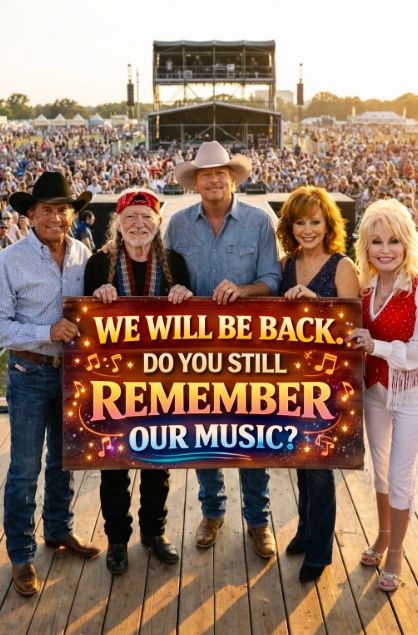
Together, these five do more than represent country music. They define its emotional architecture.
That is what makes the imagined force of this moment so compelling. It strips away everything artificial and leaves only what matters: song, presence, character, and lived experience. In an age obsessed with velocity, virality, and surface, a gathering like this reminds listeners that country music was never meant to be disposable. It was built to last because it was built on things that last — heartbreak, devotion, memory, regret, faith, resilience, home, and the stubborn hope that people can endure more than they think they can.
The line between nostalgia and relevance is often misunderstood. Nostalgia alone can feel decorative, even passive. But this kind of moment is not passive. It is active, almost corrective. It says that tradition is not a museum piece. It breathes. It still has weight. It still has authority. And when artists of this stature share a stage, they do not appear as relics from a better time. They appear as proof that substance never goes out of style.
That is why the crowd rises. Not out of politeness. Not out of habit. They rise because something inside them recognizes what is happening. They are not just watching famous performers. They are witnessing continuity. They are seeing the past, present, and moral center of country music standing shoulder to shoulder under one light.
And in that moment, country music does not whisper for attention. It does not beg to be noticed. It does what it has always done when it is most powerful.
It roars.
Video