Introduction
When the Strongest Women in Country Music Became Loretta Lynn’s Last Line of Grace
There are moments in country music that feel bigger than performance. They rise above applause, beyond the polished choreography of a live show, and settle somewhere much deeper—into memory, into feeling, into the quiet places where devotion and dignity still matter. What happened when Loretta Lynn took that step at the Grand Ole Opry belongs to that rare category. It was not simply a stage incident. It was a human moment, fragile and raw, involving three women whose names are written into the foundation of American music.
THE QUEEN HAD NEVER WEPT IN FRONT OF A CROWD. UNTIL SHE MISSED THAT STEP. That line does not strike the heart because it is dramatic. It strikes the heart because it feels true to everything Loretta Lynn represented. She was never an artist who built her greatness on spectacle. She built it on endurance. On honesty. On a voice that carried coal dust, heartbreak, motherhood, pride, pain, and perseverance in equal measure. By the time she entered her later years, the strength that had once seemed almost indestructible had grown visibly delicate. And yet, like so many artists of her generation, she still felt the pull of the stage—not as vanity, but as duty. The audience had given her a lifetime of love, and she wanted to give something back, even when her body no longer moved with the certainty it once had.
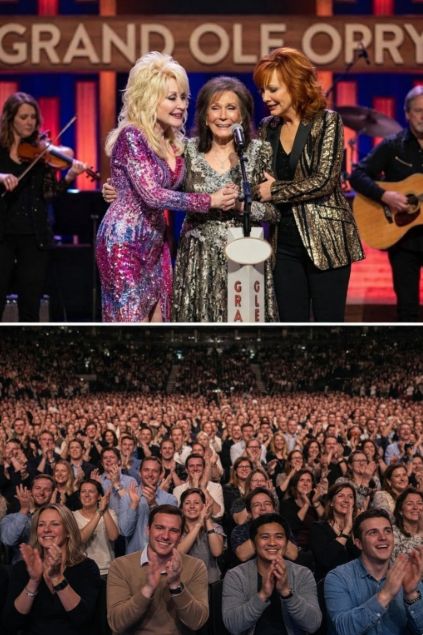
That is what makes the image so unforgettable. In a room filled with reverence, Loretta rose to sing one more time. The crowd was not merely watching a legend perform. They were witnessing a woman who had spent decades standing tall in the face of hardship, determined to do so again. Then came that terrible instant—small in movement, enormous in meaning—when her knees gave way and an entire auditorium seemed to freeze. It was the kind of silence only true fear can create, the silence of people suddenly confronted with the vulnerability of someone they love.
And then came Dolly Parton and Reba McEntire.
What happened next is what gives this scene its emotional power. These were not just fellow stars stepping in to assist a colleague. These were two women who understood exactly who Loretta was, exactly what she meant, and exactly how to protect not only her body, but her pride. Dolly from one side, Reba from the other, moving without hesitation, without calculation, without a trace of performance in the act. They did not rush her away. They did not turn the moment into pity. They held her up. They made themselves into a shield. In that instant, stardom disappeared, and sisterhood took over.
There is something profoundly moving about the image of those three women together at the microphone. Not because it looked triumphant in the usual sense, but because it revealed a deeper kind of triumph—the triumph of loyalty, of shared history, of grace under pressure. The band rising into one of Loretta’s classics only deepened the symbolism. This was no longer just a song. It was a testimony. A reminder that country music, at its best, has always been about carrying one another through the hard miles.
For older listeners especially, moments like this resonate because they speak to truths that youth often overlooks. Greatness is not only found in flawless performance. Sometimes it is found in the trembling hand that still reaches for the microphone. Sometimes it is found in the friends who refuse to let you fall alone. And sometimes the most unforgettable sight in all of music is not a standing ovation, but three women—each a giant in her own right—standing shoulder to shoulder, holding up a queen as if the whole history of country music depended on it. In that moment, perhaps it did.