At first glance, Budweiser’s 2026 Super Bowl commercial appeared to be doing exactly what it has done for decades — delivering a familiar, carefully composed piece of Americana, built from wide-open landscapes, iconic animals, and music designed to stir a sense of nostalgia that feels as old as the country itself.
But somewhere in the middle of that minute-long spot, something happened that no director called for, no storyboard predicted, and no marketing executive could have manufactured, yet it became the emotional core of the entire Super Bowl broadcast.
It was the moment when a bald eagle chick, still young enough to wobble as it walked and far from strong enough to take flight, approached one of Budweiser’s massive Clydesdale horses and, in an action driven by instinct rather than instruction, climbed onto the horse’s back and stayed there.
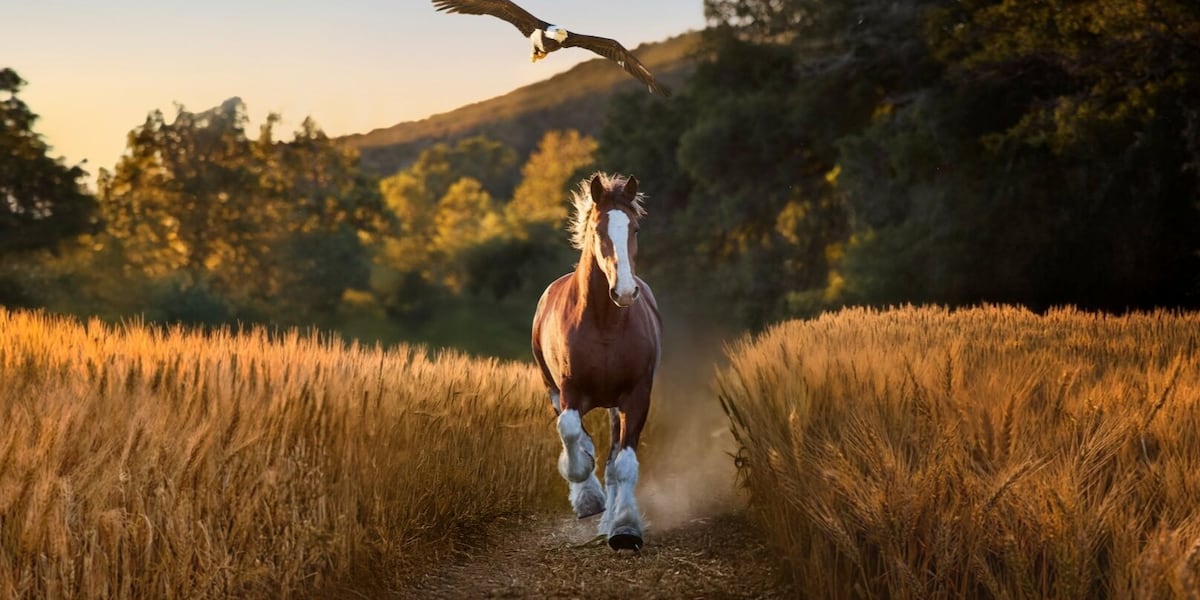
The camera did not cut away.
The horse did not react.
And the crew, stunned into silence, made the decision that would define the ad’s legacy: they let the moment unfold.
As the Clydesdale continued forward at its slow, deliberate pace, the eagle perched calmly on its back, feathers ruffled slightly by the movement, the contrast between fragility and strength unfolding in real time in a way that felt intimate rather than performative, honest rather than symbolic — even though it would quickly become both.
Sources close to the production later confirmed that the interaction had never been planned, rehearsed, or discussed in advance, with the eagle expected to remain grounded under the supervision of licensed wildlife handlers operating under strict federal guidelines, making its choice to climb onto the horse not only unexpected, but extraordinary.
One crew member described the atmosphere on set as “completely frozen,” explaining that no one spoke, no one moved, and no one dared interrupt what felt like a moment of trust forming between two animals that had no concept of cameras, brands, or broadcast deadlines.
That trust, viewers would later say, was exactly what made the scene land with such unexpected force.
As the ad aired during Super Bowl LX, social media reacted almost instantly, not with jokes or debate, but with something closer to collective reflection, as viewers described feeling emotional without fully understanding why, or replaying the clip repeatedly to confirm that what they had seen was real.
:max_bytes(150000):strip_icc():focal(731x445:733x447)/budweiser-super-bowl-2026-012626-1-045127c690274e538eccf1e2a2885f51.jpg)
On X, users wrote about how the scene made them pause mid-conversation, how it felt quieter than anything else that night, and how it seemed to say more about the country’s emotional state than any speech or spectacle could, while Reddit threads filled with long-form discussions about symbolism, vulnerability, and the exhaustion people felt after years of noise, outrage, and performance.
What struck so many viewers was the inversion of expectation.
The bald eagle — America’s most enduring symbol of freedom, power, and dominance — did not soar.
Instead, it stayed grounded.
And the Clydesdale — a symbol of labour, strength, and forward motion — did not charge ahead or assert control, but slowed just enough to carry something fragile without resistance.
For many, the image felt less like an advertisement and more like a quiet metaphor for a nation craving steadiness, patience, and a place to rest.
:max_bytes(150000):strip_icc():focal(710x242:712x244)/Stable-Budweiser-Super-Bowl-Teaser-011426-eb143348038748a39876825d39faa18b.jpg)
Budweiser later confirmed that no CGI was used to enhance the interaction, and that the footage appeared exactly as it was captured, with the creative team choosing not to explain the moment through narration, captions, or messaging, trusting instead that viewers would understand it emotionally rather than intellectually.

That decision, marketing analysts say, may be why the scene resonated so deeply, standing in stark contrast to the hyper-edited, celebrity-driven commercials that filled the rest of the broadcast.
Within days, the ad surpassed one million views online, not because it shouted for attention, but because people kept returning to it, replaying the same quiet seconds where nothing dramatic happened — except everything.
Budweiser’s Clydesdales have appeared in Super Bowl commercials for nearly half a century, and the brand’s 2026 spot was meant to celebrate its 150th anniversary, but insiders now acknowledge that the moment most likely to be remembered was the one they never intended to create.
In a night defined by volume, spectacle, and excess, the image of a small eagle trusting a larger animal enough to climb onto its back — and of that animal choosing gentleness over reaction — became the Super Bowl’s most enduring image.
There was no slogan to explain it.
No voice to tell viewers what it meant.
Just a fleeting, unscripted moment that millions of people felt, perhaps because it reflected something they themselves were missing.
And sometimes, those are the moments that stay the longest.
VIDEO BELOW