Introduction
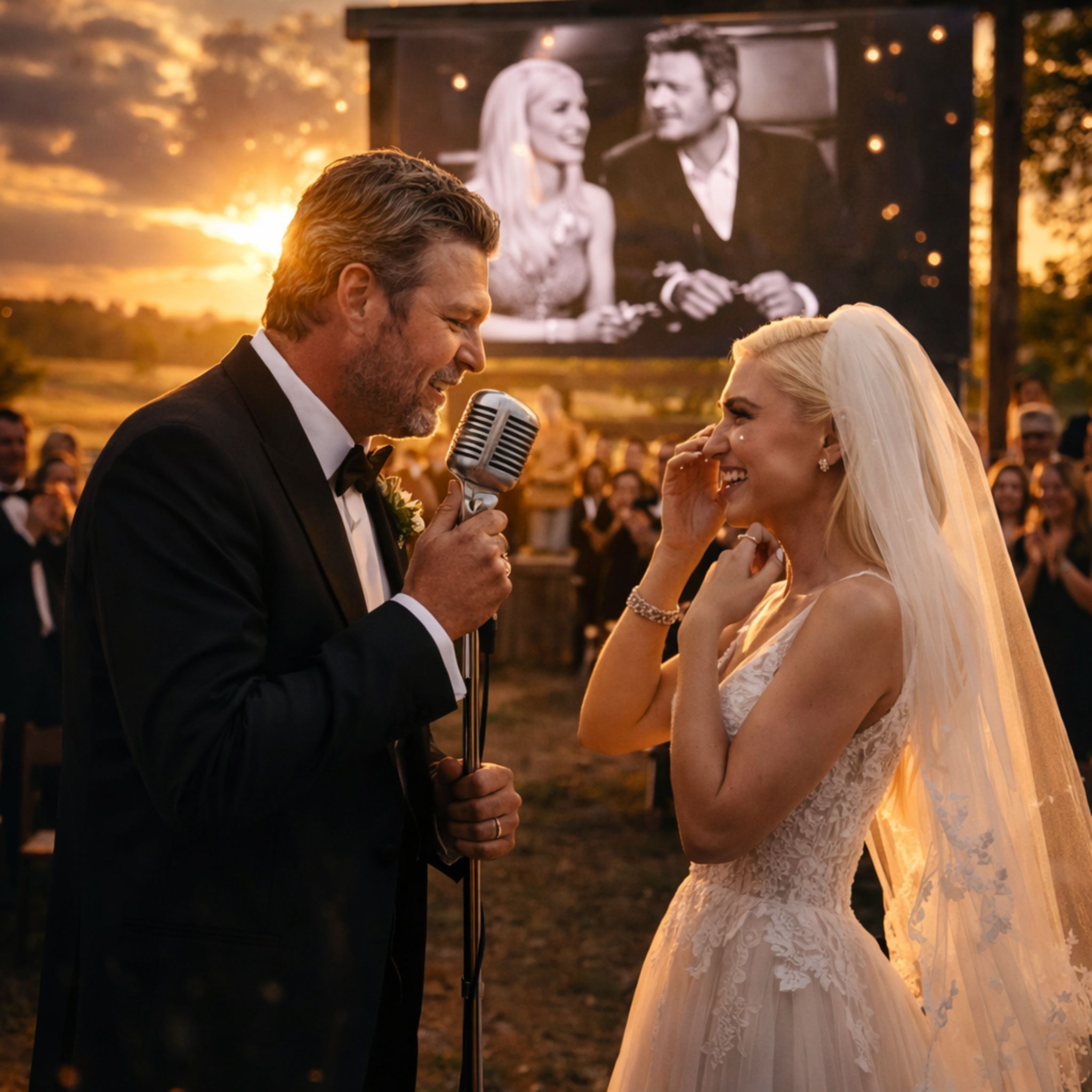
The Unheard Message That Said More Than Any Love Song Ever Could
Some love stories arrive with grand entrances. Others begin in quieter, more fragile ways — not with certainty, but with recognition. The most enduring romances in music are often not the ones built on glamour or perfect timing, but the ones shaped in the aftermath of disappointment, when two people meet not as polished versions of themselves, but as they really are: bruised, wary, and quietly hoping life may still have something kind left to offer. That is what gives “THE VOICEMAIL BEFORE “I DO” — HOW BLAKE SHELTON AND GWEN STEFANI TURNED HEARTBREAK INTO COUNTRY MUSIC’S MOST UNEXPECTED LOVE STORY” such emotional force. It is not simply the story of two celebrities finding each other. It is the story of two people arriving at love by way of survival.
What makes this narrative especially compelling is that it resists fantasy. It does not ask us to believe in some immediate, fairy-tale version of romance. Instead, it gives us something far more believable, and therefore far more moving: two adults who met in the middle of personal collapse and slowly discovered that brokenness does not always end a story. Sometimes, it is where the real one begins.
“THE VOICEMAIL BEFORE “I DO” — HOW BLAKE SHELTON AND GWEN STEFANI TURNED HEARTBREAK INTO COUNTRY MUSIC’S MOST UNEXPECTED LOVE STORY” immediately signals that this is not only about public romance, but about private tenderness — the hidden, almost sacred details that matter more than headlines ever do. A voicemail is such a simple thing. It is intimate without being theatrical. It is personal, imperfect, fleeting. And yet, as a symbol, it carries enormous weight. Songs are written for the world. Voicemails are often left for one person alone. That contrast is what gives the title its ache. It suggests that before the vows, before the photographs, before the applause that always follows a celebrity union, there was a voice in the quiet — one person reaching for another in a form too small and human to be turned into spectacle.

The emotional backbone of the story lies in the setting of 2015, when both Blake Shelton and Gwen Stefani found themselves under the bright lights of a television world that rewards charisma but rarely makes room for private pain. The brilliance of this introduction is that it does not romanticize the wreckage. It acknowledges it. He is described as a man reeling from a loss the public thought impossible. She is shown trying to steady herself after the end of a long and deeply rooted chapter of her life. There is dignity in that framing. It does not reduce either of them to tabloid characters. Instead, it presents them as two people carrying sorrow in a place where sorrow is hardest to protect.
For older readers especially, this makes the story resonate more deeply. Life teaches that love does not always arrive when we are ready, and it certainly does not always arrive when we look our best. Often it appears in those strange seasons when we are least interested in beginning again. The phrase “It looked like survival” may be the most honest line in the entire piece, because that is how many meaningful relationships begin — not with certainty, but with relief. Not with fireworks, but with the comfort of being understood without needing to explain every wound.
That is where the country element of this story becomes especially rich. Country music, at its best, has always been less interested in perfection than in truth. It has made room for heartbreak, second chances, uneasy beginnings, and the grace of ordinary tenderness. Even though Gwen Stefani comes from a different musical world, the emotional structure here feels unmistakably country: pain first, honesty second, and love arriving almost shyly in the spaces left behind. Blake Shelton, as a storyteller shaped by heartland plainspokenness, becomes a fitting center for that kind of emotional universe. And the idea that the relationship was ultimately sealed not by spectacle, but by an unreleased song and a saved voicemail, feels profoundly in tune with country music’s deepest instincts. The things that matter most are often the things the public never hears.

There is also something quietly beautiful in the image of the Oklahoma ranch, far removed from Hollywood noise. It suggests that true belonging is not found in cameras, career narratives, or public approval, but in retreat — in the place where two people can finally stop performing their lives and simply live them. That is why the final line about “two wounded hearts finding home in the same silence” lands with such grace. It avoids sentimentality by being emotionally precise. Silence here is not emptiness. It is trust. It is peace. It is the rare moment when neither person needs to fill the air with explanations.
In the end, what makes “THE VOICEMAIL BEFORE “I DO” — HOW BLAKE SHELTON AND GWEN STEFANI TURNED HEARTBREAK INTO COUNTRY MUSIC’S MOST UNEXPECTED LOVE STORY” so affecting is that it understands love as refuge rather than spectacle. It suggests that the greatest romance of this story was not the one the world watched unfold, but the one built quietly behind the scenes — in laughter after loss, in shared understanding, in unreleased songs, and in one small message kept close because it says what public language never fully can.
That is the kind of love story older audiences tend to trust: not perfect, not flashy, not naïve, but earned. And perhaps that is why it lingers. Because beneath the fame, beneath the mythology, beneath the wedding and the whispers, it offers something timeless — the hope that even after heartbreak, two people may still find their way to the same porch light, the same song, and the same stillness at the end of the day.