“He Never Asked Us to Call Him Dad — So We Sang It Instead.”

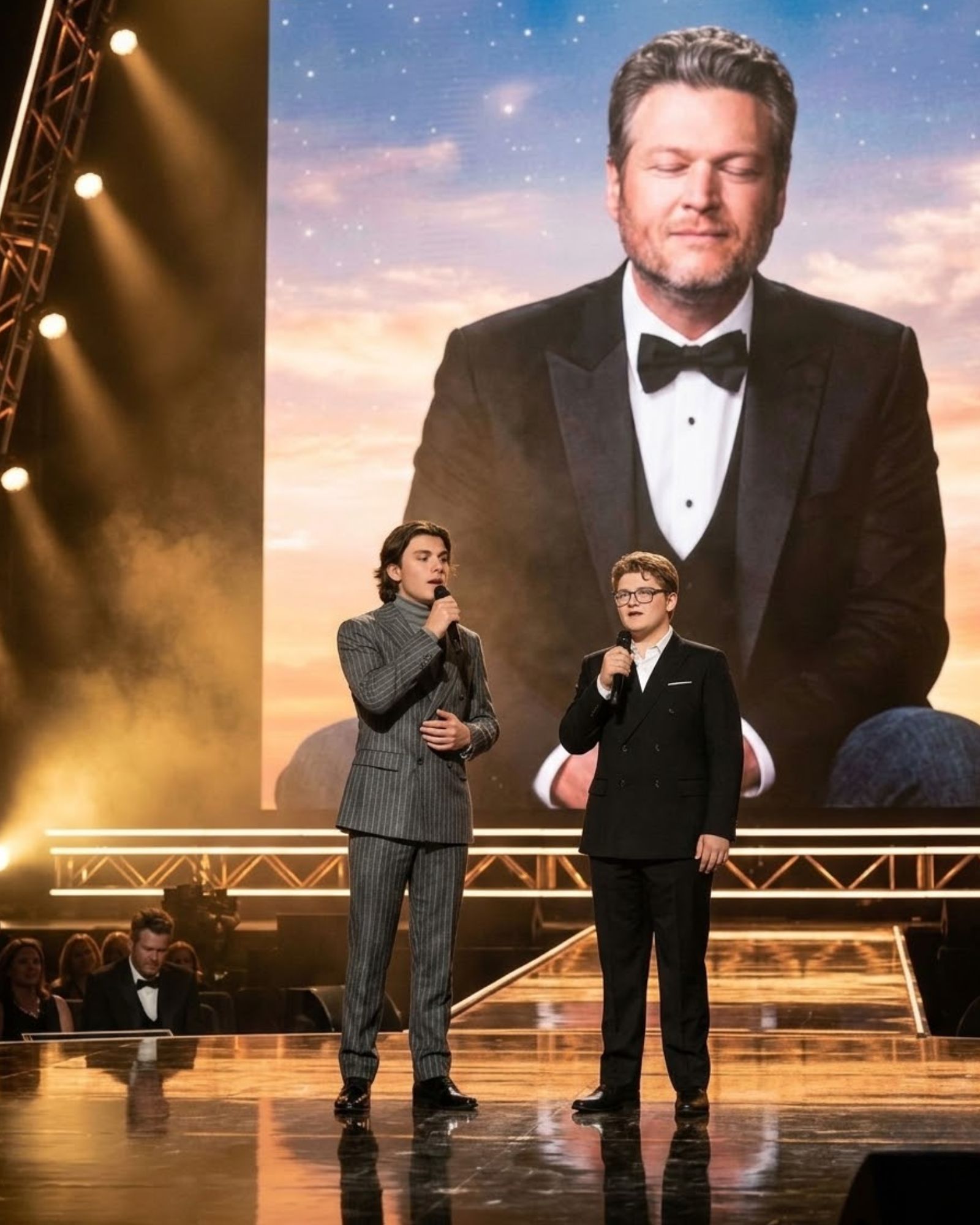
“HE NEVER ASKED US TO CALL HIM DAD — SO WE SANG IT INSTEAD.” — ZUMA ROSSDALE, NASHVILLE CENTER. The Nashville Center went quiet. Not empty-quiet — the kind of quiet where everyone leans in a little closer. Zuma and Kingston Rossdale walked onto that stage like it was just another evening. No big entrance. No fanfare. Just two boys, soft lights, and the opening notes of “Cover Me in Sunshine.” Blake Shelton didn’t sing this time. He sat still, hands folded, head slightly bowed. A man who’s held stadiums in his voice — completely undone by two voices that call him family. There was no showmanship. Just breath, timing, and pauses that said more than lyrics ever could. What Blake whispered to them after the last note may be the part no one expected… ▶️Listen this song in the 𝗳𝗶𝗿𝘀𝘁 𝗰𝗼𝗺𝗺𝗲𝗻𝘁 👇
“He Never Asked Us to Call Him Dad — So We Sang It Instead.”

The Nashville Center went quiet in a way that felt almost sacred. Not the silence of an empty room, but the kind that happens when hundreds of people suddenly understand that something tender is about to unfold.

Zuma Rossdale and Kingston Rossdale stepped into the light without drama. No giant entrance. No big announcement. No polished speech to tell the audience how to feel. Just two boys, a stage washed in soft color, and the first gentle notes of “Cover Me in Sunshine.”

It did not feel like a performance built for applause. It felt like something more private somehow made visible.

Blake Shelton did not stand at center stage. Blake Shelton did not reach for a microphone or try to turn the moment into one more headline. Blake Shelton stayed seated, hands folded, shoulders still, head slightly lowered as if any movement at all might break whatever fragile truth was rising in front of him.

For years, the world has known Blake Shelton as the loud laugh, the quick wit, the easy confidence. The kind of man who can own an arena with one line and make a crowd feel like an old friend. But family has changed the shape of that public image. Since marrying Gwen Stefani, Blake Shelton has spoken more openly about the responsibility and gratitude he feels toward the life the two of them built together, including Gwen Stefani’s sons, Kingston Rossdale, Zuma Rossdale, and Apollo Rossdale.

That was what made the moment feel so different. The audience was not watching a star being celebrated. The audience was watching a man being trusted.

A Song That Said What Conversation Sometimes Can’t

Zuma Rossdale and Kingston Rossdale sang with a softness that made the room lean closer. There was no need for huge vocal runs or dramatic gestures. The power came from restraint. A held note. A breath between lines. A quick glance toward Blake Shelton that seemed to say more than any speech could manage.

“Cover me in sunshine.” In another setting, it might have sounded bright and playful. Here, it sounded protective. Grateful. Almost like a promise.

Anyone who has lived inside a blended family understands the quiet complexity of moments like that. Love does not always arrive with a title. It does not always ask for a role. Sometimes it shows up in rides home, in patient listening, in staying when no one is asking for applause. Sometimes it earns its name slowly.

Maybe that was why the performance landed so deeply. It was not really about whether anyone used the word “dad.” It was about the fact that Blake Shelton never seemed to demand one. Blake Shelton simply kept showing up.

The Part No One Expected

When the final note faded, the room stayed still for one long second. Then another. The crowd did not rush to break it. Even applause felt too small at first.

Zuma Rossdale looked toward Blake Shelton. Kingston Rossdale gave the kind of half-smile people wear when they know they have made it through something emotional without falling apart. Blake Shelton finally stood, crossed the short distance to them, and pulled both boys close.

No cameras could fully catch what passed across Blake Shelton’s face in that instant. Pride was there. So was surprise. But more than either of those, there was the look of a man who realized that love had come back to him in a form he had never asked for and never expected to need.

What Blake Shelton whispered after the song was not loud enough for the room. Only the boys heard it clearly. But those close to the stage said Blake Shelton’s voice broke when Blake Shelton thanked them.

“You didn’t have to say it,” Blake Shelton reportedly whispered. “I heard it anyway.”

That may have been the line nobody expected. Not because it was dramatic, but because it was simple. And simple truth tends to land hardest.

Why Moments Like This Stay With People

Long after the lights go down, audiences rarely remember perfection. They remember honesty. They remember the pause before tears. They remember the way one song can suddenly reveal the shape of a family more clearly than years of interviews ever could.

That night at the Nashville Center, Zuma Rossdale and Kingston Rossdale did not give Blake Shelton a trophy, a tribute speech, or a carefully rehearsed declaration. They gave Blake Shelton something quieter and, maybe because of that, far more lasting.

They gave Blake Shelton a song.

And for one suspended moment, that seemed to say everything.

::contentReference[oaicite:0]{index=0}

Related Posts

He Didn’t Walk Away Right Away: The Night Blake Shelton Let the Applause Tell the Whole Story

Introduction He Didn’t Walk Away Right Away: The Night Blake Shelton Let the Applause Tell the Whole Story There are moments in live music when the performance…

When the Sun Went Down on Toby Keith, Blake Shelton and Trace Adkins Gave Him the Kind of Goodbye Fame Could Never Improve

Introduction When the Sun Went Down on Toby Keith, Blake Shelton and Trace Adkins Gave Him the Kind of Goodbye Fame Could Never Improve There are moments…

WHEN THE ARENA FADED AWAY — Blake Shelton and the Moment a Song Became Personal

Introduction WHEN THE ARENA FADED AWAY — Blake Shelton and the Moment a Song Became Personal There are performances that belong to the crowd, shaped by applause…

The Unheard Message That Said More Than Any Love Song Ever Could

Introduction The Unheard Message That Said More Than Any Love Song Ever Could Some love stories arrive with grand entrances. Others begin in quieter, more fragile ways…

“When Kurt Russell & Goldie Hawn Returned… Time Stood Still.”

A moments from the 1989 Academy Awards: their fake-out marriage proposal bit with longtime partner Goldie Hawn. @KT The couple, who have been together since 1983 (and still…

When the Storm Came for Shania Twain, It Left Reminding the World Why Legends Endure

Introduction When the Storm Came for Shania Twain, It Left Reminding the World Why Legends Endure There are nights in music that feel carefully planned, polished down to the last light cue and perfectly timed entrance. And then there are the rare nights no one could have scripted — nights when weather, chance, and human character collide, and what remains is not merely entertainment, but revelation. That is the emotional force behind SHANIA TWAIN SMILED IN THE RAIN — AND IN ONE STORM-SOAKED NIGHT, SHE SILENCED EVERY DOUBT WITHOUT RAISING HER VOICE. It is a title that resonates because it captures something larger than a concert. It captures the moment a performer stops looking like a star and starts looking like something even rarer: unshakable. Rain has always had a way of testing performers in the harshest, most immediate terms. It dissolves the illusion of control. It turns the stage into uncertainty. It strips away the comforts artists rely on — the flawless pacing, the pristine production, the ease of movement, the sense that every second belongs to the plan. Under those conditions, what remains is the artist alone: instinct, nerve, presence, and truth. And that is precisely why the image of Shania Twain smiling through the storm feels so powerful. She did not appear rattled by the sky opening above her. She appeared almost answered by it. What makes the moment so striking is not simply that she continued. It is the manner in which she continued. There was no sense of panic, no visible resentment at the disruption, no plea for sympathy. Instead, there was composure — and something even more commanding than composure: delight. That smile changed the meaning of the entire scene. What could have looked like a setback suddenly became theater of the highest kind, not because it was staged, but because she had the confidence to inhabit it completely. The storm did not diminish her presence. It amplified it. For longtime listeners, that image carries special meaning. Shania Twain has never been just a voice attached to a catalog of major hits. She has long represented resilience in a form that is both elegant and unmistakably strong. Across decades, she has stood at the intersection of reinvention, criticism, public scrutiny, and extraordinary success. She has been underestimated, imitated, celebrated, questioned, and then celebrated all over again. That history matters, because it gives emotional depth to a scene like this. When she smiles in the rain, it does not look like a performer improvising through inconvenience. It looks like a woman who has already weathered more difficult storms than this one — and knows perfectly well who she is. That is why the moment feels larger than spectacle. The thunder, the rain-slick stage, the shimmering lights, the soaked fabric, the steel in her voice — all of it becomes symbolic. For the generations watching, especially those who have followed her across many chapters of fame and transformation, it is not only impressive. It is affirming. It reminds them that true artistic authority does not depend on perfect conditions. In some ways, perfect conditions can hide a performer. Difficulty reveals one. And what the rain revealed in Shania Twain was not fragility, but command. There is also something deeply satisfying in the quietness of her victory. She did not need a dramatic speech. She did not need to answer critics directly, defend her place, or force the moment into a declaration. She simply stood in the storm and owned it. That kind of confidence is more persuasive than argument. It is why the phrase SHANIA TWAIN SMILED IN THE RAIN — AND IN ONE STORM-SOAKED NIGHT, SHE SILENCED EVERY DOUBT WITHOUT RAISING HER VOICE lands with such force. It describes a triumph achieved not through confrontation, but through presence. In the end, nights like this become part of an artist’s mythology because they reveal something audiences instinctively understand. Songs may build a legacy, but character seals it. On that storm-soaked night, Shania Twain did more than perform through bad weather. She turned adversity into imagery, pressure into poise, and doubt into irrelevance. She did not fight the storm. She outlasted it with a smile. And for everyone watching, that was the moment the rain stopped feeling like an obstacle and started feeling like proof.