WHEN THE ARENA FADED AWAY — Blake Shelton and the Moment a Song Became Personal

Introduction

WHEN THE ARENA FADED AWAY — Blake Shelton and the Moment a Song Became Personal

There are performances that belong to the crowd, shaped by applause and amplified by spectacle. And then there are those rare, almost unnoticeable moments when something shifts — when the scale of a concert quietly narrows, and the energy of an arena settles into something far more intimate. It is in these moments that an artist reveals not just their craft, but their humanity.

That night, the feeling was captured perfectly in the line: “THE CROWD CHEERED. BLAKE SHELTON JUST LOOKED FOR ONE FACE.” It speaks to something that cannot be rehearsed or manufactured. Blake Shelton has spent years standing before thousands, commanding stages with ease and familiarity. Yet on this occasion, his focus seemed elsewhere — not scattered across the vastness of the audience, but drawn, almost instinctively, toward a single point.

From the beginning, there was a subtle difference in his presence. He did not move with the expansive gestures that often define arena performances. Instead, there was a quiet steadiness, as though he were anchoring himself to something unseen. And as the song unfolded, that quiet intention became more apparent.

When he reached the chorus, his voice did not grow louder — it grew closer. There was a softness, not in strength, but in direction. It felt less like a projection and more like a conversation, one carried across distance but meant for a single listener. The words, familiar to many, seemed to take on a different weight in that moment.

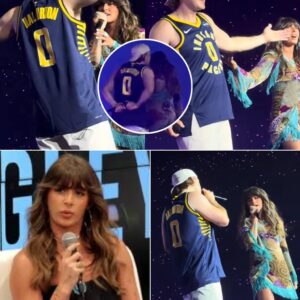
Somewhere in the front rows, Gwen Stefani sat without fanfare, without the need for recognition. There was no spotlight drawing attention to her, no gesture from the stage to confirm what many might suspect. And yet, for those paying close attention, the connection was unmistakable. It was not declared — it was understood.

What made the moment so compelling was its restraint. Blake did not break character, did not interrupt the performance to acknowledge what was happening. Instead, he allowed the song to carry that meaning quietly, trusting that it would be felt rather than announced.

And when the final note faded and the audience responded with their usual enthusiasm, there was a brief, telling pause. A single smile — subtle, almost private — as he saw her stand and clap.

It is often said that music connects people. But on that night, it did something even more rare. It revealed a connection that already existed — steady, enduring, and unspoken. A reminder that even in the largest of spaces, the most meaningful performances are sometimes the ones meant for just one person.


Video

Related Posts

“He Never Asked Us to Call Him Dad — So We Sang It Instead.”

“HE NEVER ASKED US TO CALL HIM DAD — SO WE SANG IT INSTEAD.” — ZUMA ROSSDALE, NASHVILLE CENTER. The Nashville Center went quiet. Not empty-quiet —…

He Didn’t Walk Away Right Away: The Night Blake Shelton Let the Applause Tell the Whole Story

Introduction He Didn’t Walk Away Right Away: The Night Blake Shelton Let the Applause Tell the Whole Story There are moments in live music when the performance…

When the Sun Went Down on Toby Keith, Blake Shelton and Trace Adkins Gave Him the Kind of Goodbye Fame Could Never Improve

Introduction When the Sun Went Down on Toby Keith, Blake Shelton and Trace Adkins Gave Him the Kind of Goodbye Fame Could Never Improve There are moments…

The Unheard Message That Said More Than Any Love Song Ever Could

Introduction The Unheard Message That Said More Than Any Love Song Ever Could Some love stories arrive with grand entrances. Others begin in quieter, more fragile ways…

“When Kurt Russell & Goldie Hawn Returned… Time Stood Still.”

A moments from the 1989 Academy Awards: their fake-out marriage proposal bit with longtime partner Goldie Hawn. @KT The couple, who have been together since 1983 (and still…

When the Storm Came for Shania Twain, It Left Reminding the World Why Legends Endure

Introduction When the Storm Came for Shania Twain, It Left Reminding the World Why Legends Endure There are nights in music that feel carefully planned, polished down to the last light cue and perfectly timed entrance. And then there are the rare nights no one could have scripted — nights when weather, chance, and human character collide, and what remains is not merely entertainment, but revelation. That is the emotional force behind SHANIA TWAIN SMILED IN THE RAIN — AND IN ONE STORM-SOAKED NIGHT, SHE SILENCED EVERY DOUBT WITHOUT RAISING HER VOICE. It is a title that resonates because it captures something larger than a concert. It captures the moment a performer stops looking like a star and starts looking like something even rarer: unshakable. Rain has always had a way of testing performers in the harshest, most immediate terms. It dissolves the illusion of control. It turns the stage into uncertainty. It strips away the comforts artists rely on — the flawless pacing, the pristine production, the ease of movement, the sense that every second belongs to the plan. Under those conditions, what remains is the artist alone: instinct, nerve, presence, and truth. And that is precisely why the image of Shania Twain smiling through the storm feels so powerful. She did not appear rattled by the sky opening above her. She appeared almost answered by it. What makes the moment so striking is not simply that she continued. It is the manner in which she continued. There was no sense of panic, no visible resentment at the disruption, no plea for sympathy. Instead, there was composure — and something even more commanding than composure: delight. That smile changed the meaning of the entire scene. What could have looked like a setback suddenly became theater of the highest kind, not because it was staged, but because she had the confidence to inhabit it completely. The storm did not diminish her presence. It amplified it. For longtime listeners, that image carries special meaning. Shania Twain has never been just a voice attached to a catalog of major hits. She has long represented resilience in a form that is both elegant and unmistakably strong. Across decades, she has stood at the intersection of reinvention, criticism, public scrutiny, and extraordinary success. She has been underestimated, imitated, celebrated, questioned, and then celebrated all over again. That history matters, because it gives emotional depth to a scene like this. When she smiles in the rain, it does not look like a performer improvising through inconvenience. It looks like a woman who has already weathered more difficult storms than this one — and knows perfectly well who she is. That is why the moment feels larger than spectacle. The thunder, the rain-slick stage, the shimmering lights, the soaked fabric, the steel in her voice — all of it becomes symbolic. For the generations watching, especially those who have followed her across many chapters of fame and transformation, it is not only impressive. It is affirming. It reminds them that true artistic authority does not depend on perfect conditions. In some ways, perfect conditions can hide a performer. Difficulty reveals one. And what the rain revealed in Shania Twain was not fragility, but command. There is also something deeply satisfying in the quietness of her victory. She did not need a dramatic speech. She did not need to answer critics directly, defend her place, or force the moment into a declaration. She simply stood in the storm and owned it. That kind of confidence is more persuasive than argument. It is why the phrase SHANIA TWAIN SMILED IN THE RAIN — AND IN ONE STORM-SOAKED NIGHT, SHE SILENCED EVERY DOUBT WITHOUT RAISING HER VOICE lands with such force. It describes a triumph achieved not through confrontation, but through presence. In the end, nights like this become part of an artist’s mythology because they reveal something audiences instinctively understand. Songs may build a legacy, but character seals it. On that storm-soaked night, Shania Twain did more than perform through bad weather. She turned adversity into imagery, pressure into poise, and doubt into irrelevance. She did not fight the storm. She outlasted it with a smile. And for everyone watching, that was the moment the rain stopped feeling like an obstacle and started feeling like proof.